




Are your employees truly engaged, or are they simply clocking in and out? Do you feel like your organisation has the spark it needs to succeed, or is something missing? If you’ve ever questioned how to build a workplace where people genuinely want to work, you’re not alone. A positive organisational culture isn’t just a nice-to-have, it’s a must. As an HR professional, you’re at the heart of shaping the employee experience. Let’s explore how you can take actionable steps to foster a culture where people thrive, collaborate, and grow.
Why Organisational Culture Matters
- Employee Engagement & Retention – A positive organisational culture directly influences how connected your employees feel to their work. When people feel valued and aligned with the company’s mission, they stay longer and perform better.
- Increased Productivity – When your employees operate in a healthy workplace culture, they’re motivated, focused, and eager to contribute. This boost in morale translates to higher productivity across departments.
- Attracting Top Talent – Candidates today don’t just look at salary. They care deeply about your company culture. A positive company culture draws in high-quality talent who are aligned with your values and goals.
- Enhanced Collaboration – Culture influences how teams communicate. A positive organisational culture fosters open communication, trust, and teamwork — all essential for successful collaboration.
- Business Growth and Innovation – Companies that prioritize organisational culture development often outperform competitors. Innovation thrives when people feel safe, supported, and encouraged to share ideas.
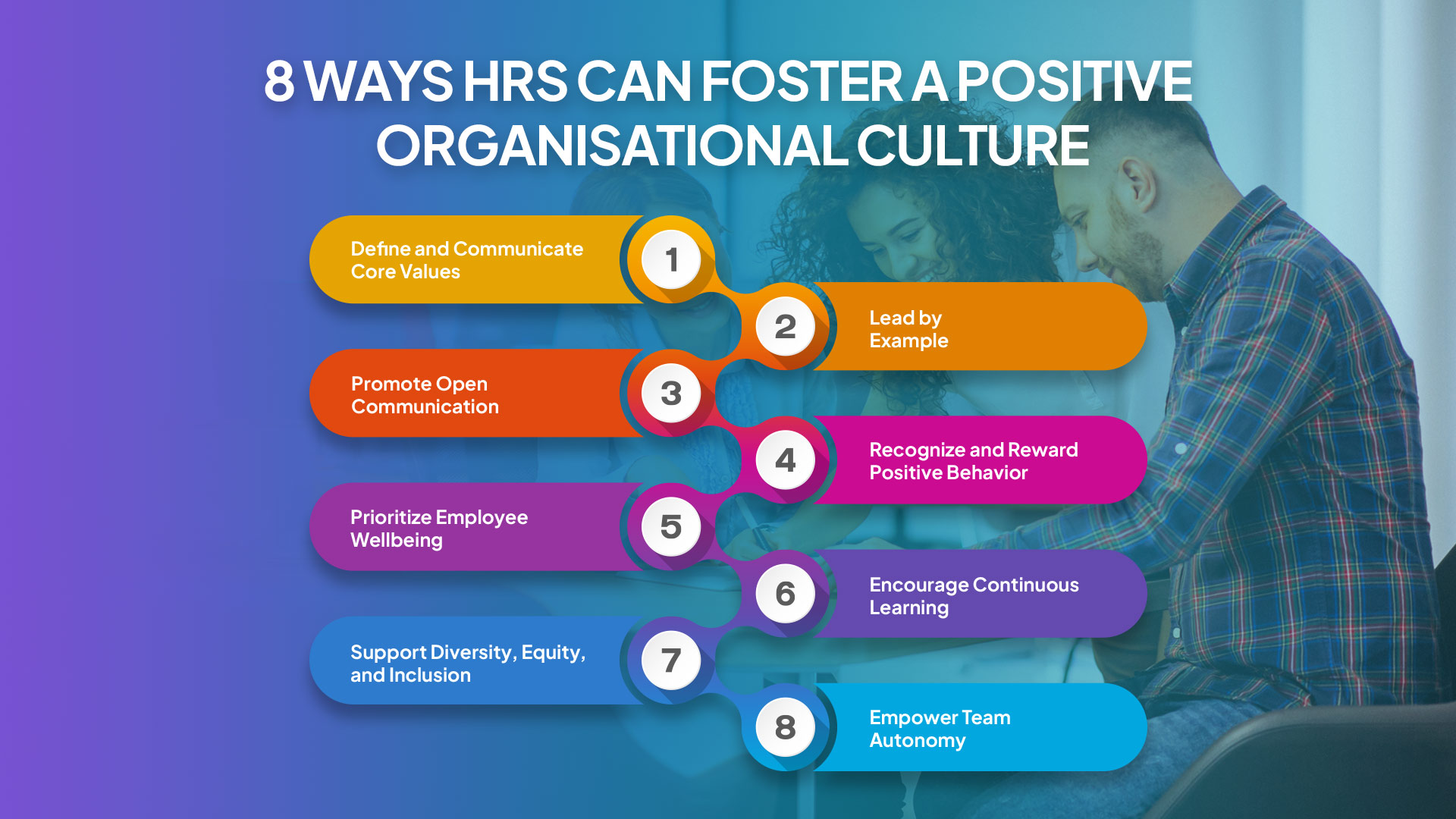
Top 8 Ways HRs Can Foster a Positive Organisational Culture
1. Define and Communicate Core Values
To create a truly positive organisational culture, you need to build a foundation based on clear and consistent core values. When your team knows what your company stands for, it’s easier for them to align their actions and decisions with your vision. As an HR leader, you must not only define these values but also bring them to life daily through communication, rituals, and systems. Values must be more than just wall art — they must shape your culture.
- Identify the values that reflect your company’s true identity.
- Communicate them consistently through meetings, onboarding, and branding.
- Reinforce them with employee recognition and leadership actions.
- Use real employee stories to make them relatable and inspiring.
2. Lead by Example
As HR, you’re in a position of influence, and your actions set the tone. A positive organisational culture doesn’t grow from policies alone — it flourishes when leadership embodies it. If you want your team to be respectful, innovative, or collaborative, you must be the first to model those behaviors. Leadership and company culture are inseparable. When leaders live the values, others follow naturally, and this shapes a more authentic and inspiring workplace.
- Practice the behaviors you want to see in your team.
- Train managers to align leadership with cultural goals.
- Show consistency between words and actions at all levels.
- Encourage transparency and vulnerability in leadership.
3. Promote Open Communication
Open communication is one of the cornerstones of a positive organisational culture. When people feel heard and safe to express their thoughts, trust grows. You should build a communication framework where employees are empowered to speak up, share ideas, and voice concerns without fear. Creating a healthy workplace culture means eliminating bottlenecks, building trust, and encouraging honest conversations that lead to action and improvement.
- Create clear channels for feedback and dialogue.
- Encourage leaders to listen with empathy and openness.
- Act on feedback and show employees their voices matter.
- Host regular town halls and internal Q&As.
4. Recognize and Reward Positive Behavior
Recognition is one of the most powerful tools to reinforce a positive organisational culture. When employees feel seen and appreciated for their contributions, their engagement skyrockets. As HR, you should build a system that consistently rewards behaviors aligned with your values. Recognition can be formal or informal, but it must be timely, genuine, and connected to your cultural vision. Celebrate the wins — both big and small — and watch motivation soar.
- Set up a structured recognition and rewards system.
- Align rewards with cultural goals and values.
- Encourage peer-to-peer appreciation and shout-outs.
- Use platforms to make recognition visible across teams.
5. Prioritize Employee Wellbeing
You can’t have a positive organisational culture without healthy, supported employees. Wellbeing goes beyond fitness perks — it includes mental health, emotional safety, and work-life balance. HR leaders like you need to advocate for a healthy workplace culture where people feel cared for and not just seen as resources. A culture of care leads to lower burnout, better retention, and a workforce that brings their best to work every day. Get in touch with us today for Recruitment process outsourcing in India!
- Provide access to mental health tools and professionals.
- Encourage flexibility and respect personal boundaries.
- Support wellness programs that address whole-person health.
- Promote a work environment that encourages taking breaks.
6. Encourage Continuous Learning
A growth mindset is essential to building a future-ready team. If you want a positive organisational culture, you must invest in your people’s development. Learning helps employees stay engaged, feel empowered, and grow with the company. HR should support training, mentoring, and other development opportunities that help individuals evolve professionally and personally. Prioritizing learning also reinforces your commitment to long-term organisational culture development.
- Offer access to online learning platforms and workshops.
- Integrate learning goals into performance reviews.
- Support mentorship and coaching within teams.
- Reward progress and celebrate learning milestones.
7. Support Diversity, Equity, and Inclusion
Diversity isn’t just a checkbox — it’s a catalyst for a thriving, positive organisational culture. When people from diverse backgrounds feel included, heard, and respected, innovation and collaboration flourish. As HR, you play a critical role in designing inclusive policies, encouraging dialogue, and creating spaces where everyone belongs. Organisational culture development must prioritize inclusion to truly unlock a culture where everyone can succeed.
- Develop inclusive hiring and promotion practices.
- Host workshops to raise awareness and empathy.
- Celebrate cultural events and employee diversity stories.
- Use metrics to track progress and accountability in DEI.
8. Empower Team Autonomy
People thrive when they feel trusted. Giving your team autonomy helps create a positive organisational culture where ownership and accountability are core values. Micromanagement kills motivation, while autonomy inspires creativity and confidence. You can lead this shift by promoting decentralized decision-making, encouraging innovation, and trusting teams to handle their responsibilities. Autonomy builds leaders, not just employees.
- Encourage team-led decision-making and innovation.
- Set clear goals but allow flexible execution.
- Train managers to shift from control to coaching.
- Recognize self-driven initiatives and ownership.
Common Culture Killers to Avoid
- Lack of Transparency – When information is withheld, it breeds distrust. Employees should never feel like they’re in the dark. Open, honest communication is vital for a positive organisational culture.
- Toxic Leadership – A single toxic leader can undo months of positive progress. If leaders don’t reflect the company’s values, culture collapses. Leadership and company culture must go hand in hand.
- Ignoring Employee Feedback – You may ask for input, but are you acting on it? If feedback is ignored, employees will stop giving it, and disengagement follows. Listening and responding are key.
- Overworking Your Teams – Long hours and constant pressure damage not just productivity, but your team’s health. To build a healthy workplace culture, prioritize balance and boundaries.
- Inconsistent Practices – If your culture isn’t reinforced consistently, it creates confusion. Your values must be present in every policy, every hire, and every review.
Conclusion
As an HR leader, you’re not just managing people, you’re shaping the soul of your organisation. When you commit to fostering a positive organisational culture, you create a ripple effect of trust, productivity, and happiness that touches every corner of your business. It’s not a one-time task, but an ongoing journey. Embrace the challenge, lead with intention, and watch your teams and your business flourish.
At 10X Hiring, a leading recruitment agency in India, our mission is to revolutionize the recruitment landscape and make the hiring process smoother for you. We take pride in being your trusted partner in building a team of top-tier professionals. Whether you’re a startup just launching, an enterprise scaling fast, or a growing business needing strategic hires, we offer tailored recruitment and staffing solutions. Let’s work together to build not just a team — but a culture that lasts.
Frequently Asked Questions (FAQs)
1. How can leaders foster a positive culture?
Leaders can foster a positive culture by leading with empathy, modeling company values, encouraging open communication, and recognizing team contributions. Their behavior sets the tone for trust, inclusion, and collaboration across the entire organization.
2. What is a positive organisational culture?
A positive organisational culture is a work environment where employees feel valued, respected, and motivated. It includes shared values, open communication, supportive leadership, and a sense of purpose, all contributing to employee well-being and company success.
3. Why is a positive work culture important?
A positive work culture boosts employee engagement, reduces turnover, improves performance, and attracts top talent. It creates a supportive environment where individuals can grow, collaborate, and align with the company’s mission, ultimately driving business success.
4. How does culture affect employee performance?
Organisational culture directly influences motivation, productivity, and teamwork. In a positive culture, employees feel supported and aligned, leading to better focus and results. A negative culture, however, often causes disengagement, low morale, and reduced efficiency.
5. What are signs of a toxic vs positive workplace culture?
A toxic culture includes high turnover, poor communication, and low morale. A positive culture shows up as mutual respect, transparent leadership, recognition, and strong collaboration. Employee satisfaction and retention are strong indicators of cultural health.
Search

Hiring Marketing Specialists vs Generalists: The ₹10 Lakh Mistake Agencies Keep Making
You won the client with a strong pitch. Six months later, they’re asking why their ad costs keep climbing, and nobody can explain it clearly. Then comes the email you

Digital Marketing Hiring: Why New Hires Fail in 90 Days (And It’s Rarely About Skills)
You interviewed well. The candidate had the right tools on their CV, a decent portfolio and a calm answer for every question. Three months later, they’re gone, or you’re quietly
How Marketing Recruitment Agencies Help You Hire Top Talent Faster
Introduction Why does hiring a good marketer sometimes take longer than launching an entire campaign? Why do the strongest candidates disappear before the interview process is complete? And what does

In-House Marketing Team vs Agency: Which One Actually Grows Your Business?
Introduction “Do you build out your own marketing team, or just hand it over to an agency that’s already been through this a hundred times?” And is in-house really the

Digital Marketing Internship Guide to Get Hired in 2026
The Internship Nobody Tells You About Here is something most career guides skip over: the digital marketing internship you land in 2026 will not look like the ones from five