You are currently viewing Graphic Design Portfolio for Students to Get Hired Faster
graphic design portfolio for students

Graphic Design Portfolio for Students to Get Hired Faster

Why Your Portfolio Matters More Than Your Degree?

Let’s be honest — in the design world, nobody is hiring a piece of paper. They are hiring your eye, your thinking, and your ability to solve problems visually. When you walk into a creative agency or send a job application online, your graphic design portfolio for students does the talking before you even get a chance to open your mouth.

Recruiters spend an average of 2–3 minutes scanning a portfolio before deciding whether to move forward. That is not a lot of time. But the good news? You do not need years of experience to build something that stops a hiring manager mid-scroll. You need strategy.This guide walks you through exactly how to build a portfolio that works for you — even if you are a fresher with zero client work and just a handful of college projects.

design portfolio tips

Start With the Right Mindset: Quality Over Quantity

One of the biggest mistakes students make is dumping every assignment they have ever completed into a PDF and calling it a portfolio. More work does not mean more impressive. Recruiters are not counting your projects — they are evaluating your judgment.
Aim for 6 to 10 strong pieces. Each project should demonstrate a clear design problem, your thought process, and the final solution. If a piece does not make you proud, cut it. A tight, focused collection of great work will always outperform a bloated one filled with mediocre fillers.

When selecting work, ask yourself:

  • Does this show range without being scattered?

  • Can I explain the thinking behind every decision?

  • Would I be excited to talk about this in an interview?

Design Portfolio Tips That Actually Work for Students

1. Lead With Your Best Piece :

Your opening project sets the tone for everything that follows. Put your strongest, most polished piece first — not your oldest or safest. Think of it as the hook in a great piece of writing. It has to grab attention immediately.

2. Show the Process, Not Just the Final Result  

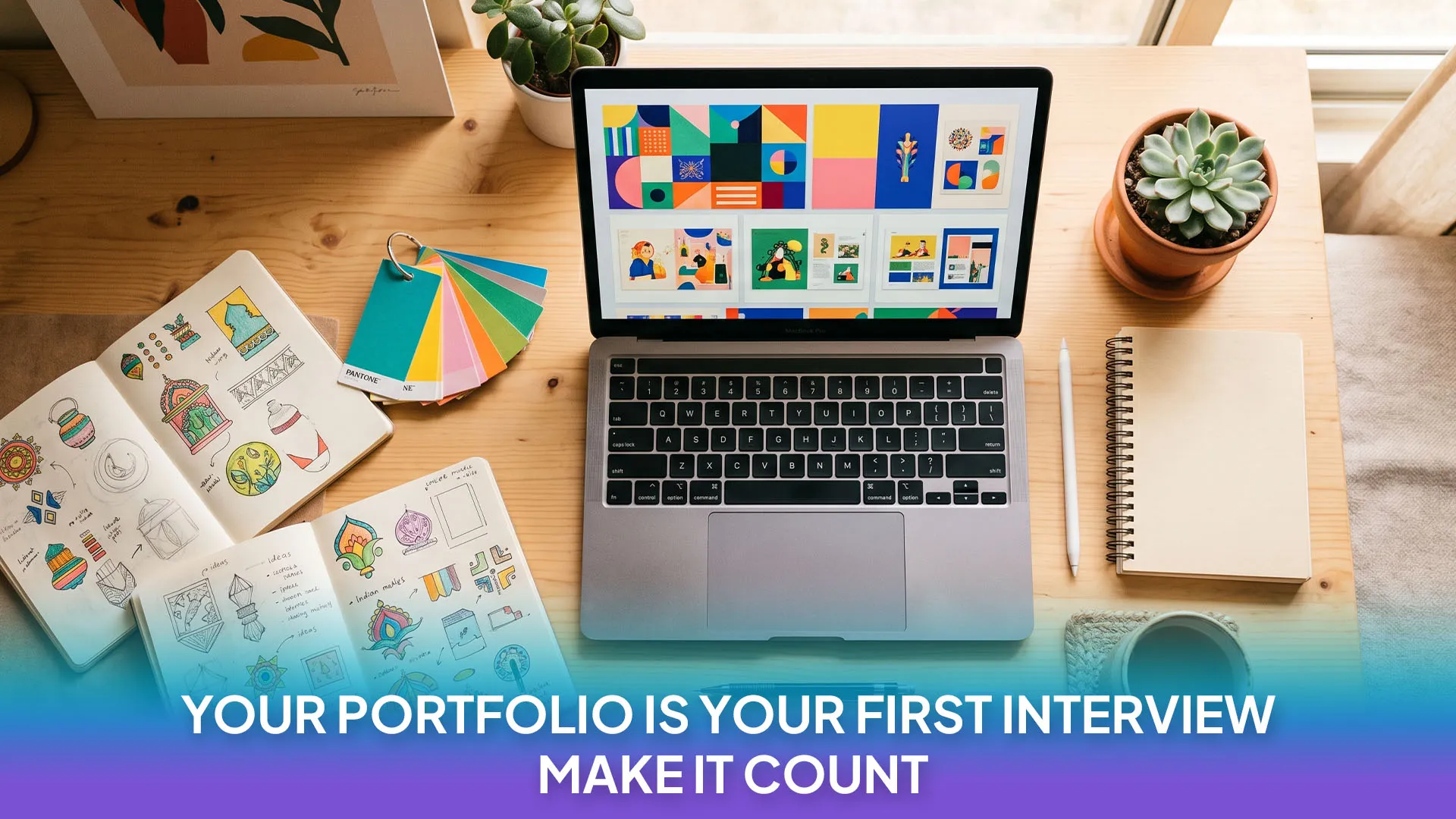
Seasoned recruiters know that great output comes from solid thinking. Include process shots — sketches, wireframes, mood boards, iteration stages. This communicates that you think like a designer, not just execute like a software user. Even rough sketches humanize your work and prove the idea was genuinely yours.

3. Write Case Studies, Not Just Captions  

For each project, write a short case study (150–250 words) that explains the brief, your approach, and the outcome. Describe why you chose certain typefaces, why the color palette fits the brand, and what you would do differently today. This level of reflection signals maturity and self-awareness — two things freshers rarely demonstrate.

4. Tailor It for the Job You Want  

Are you applying to a branding studio? Lead with brand identity work. Targeting a social media agency? Showcase digital and motion pieces. A portfolio for freshers does not need to cover everything — it needs to speak directly to the role and studio you want. Customizing your portfolio for specific job types shows intent, and intent is attractive to employers.

5. Make the Portfolio Itself a Design Project  

Your portfolio is a piece of design. Treat it that way. The layout, typography, color choices, and navigation all communicate your design sensibility before a recruiter even looks at a single project. Keep it clean, easy to navigate, and visually consistent. A messy or confusing portfolio layout undermines the work inside it.


Student Portfolio Examples: Types of Work to Include

Not sure what counts as “real” portfolio work? Here is the truth — self-initiated and conceptual projects are 100% valid, especially for students and freshers. Hiring managers understand that you are building your career from scratch. What they want to see is potential and intentionality.

Here are strong graphic design projects to consider building:

Brand Identity Projects Pick a fictional or existing local business and redesign their entire identity — logo, color system, typography, business card, and signage. This is one of the most common and well-respected portfolio pieces in the industry.

Poster and Editorial Design Choose a subject you care about — a music festival, a social cause, a film — and design a series of posters. A cohesive series of three or four posters shows pattern thinking and visual consistency.

Packaging Design Packaging projects photograph beautifully and always get attention. Design packaging for a product you use daily — a tea brand, a notebook, a skincare item. Create mockups to present it professionally.

Typography and Lettering Custom lettering or type-based compositions show off a core design skill that many students overlook. A well-executed typographic poster can be more impressive than a complex illustration.

Digital and Social Media Design Design a social media content system — templates, post layouts, story formats — for a fictional brand. This is immediately practical and signals readiness for agency work.

UI/UX Concepts (Bonus) Even a basic app screen or website concept shows you understand digital design thinking, which is increasingly valuable in the current market.

Creative Portfolio Ideas to Set Yourself Apart  

Every design student has a logo project and a poster series. To stand out, you need work that reflects your genuine interests and perspective. Some creative portfolio ideas worth considering:

  • Redesign the visual identity of a childhood brand with a modern twist

  • Create a data visualization poster on a topic you find fascinating

  • Design a zine — a small self-published booklet — on any subject you love

  • Reimagine a classic book cover in your own visual language

  • Build a motion design piece, even if it is just a 10-second animated logo

The goal is to show personality. Recruiters hire humans, not portfolios. When your work reflects a distinct voice and genuine curiosity, it becomes memorable in a way that technically correct but generic work never will.

Where to Host Your Portfolio

Even the best work needs the right platform. For students, these are the most practical options:

Behance — Free, widely used by creatives, and actively searched by recruiters. Great for project case studies and getting community feedback.

Adobe Portfolio — Clean, minimal, and integrates directly with Behance. Available free with any Adobe Creative Cloud subscription.

PDF Portfolio — Always have a polished, well-designed PDF version ready to attach to job applications. Some employers still prefer it.

Whatever platform you choose, make sure your portfolio loads fast, looks clean on mobile, and has clear contact information on every page.

Common Mistakes to Avoid

Before you hit publish, check your portfolio against these common student mistakes:

  • Including class work without context or a case study

  • Using low-resolution or poorly photographed images

  • No “About” section or contact details

  • Inconsistent formatting across project pages

  • Forgetting to proofread your writing — typos in a designer’s portfolio are a red flag

Frequently Asked Questions (FAQs)

How many projects should a graphic design student portfolio have?

Aim for 6 to 10 well-presented projects. Quality always outweighs quantity. Three exceptional, well-documented projects will outperform ten rushed, underdeveloped ones. Each piece should be something you can confidently discuss in an interview, explaining your creative decisions from start to finish.

Absolutely. Most employers hiring freshers expect portfolios to contain student work. The key is presenting it professionally — include context, a brief project description, your role, and the outcome. Treat every college project as if it were a real client brief and document it accordingly.

Brand identity projects, packaging design, editorial work, and digital design concepts tend to perform well. More than the project type, recruiters look for clear thinking, strong visual execution, and the ability to explain your process. A well-documented poster project can outshine a technically complex project with no explanation.

Having both is ideal. A portfolio website (on Behance, Adobe Portfolio, or your own domain) is easier to share via a link and looks more professional. A PDF is useful for email applications and interviews. Make sure both versions are updated, consistently designed, and easy to navigate.

Self-initiated projects, redesign concepts, fictional brand identities, and personal passion projects are all valid portfolio pieces. Volunteer for local nonprofits or student organizations to get real briefs. The creative portfolio ideas that tend to impress the most are the ones driven by genuine curiosity — not just coursework requirements.

Search